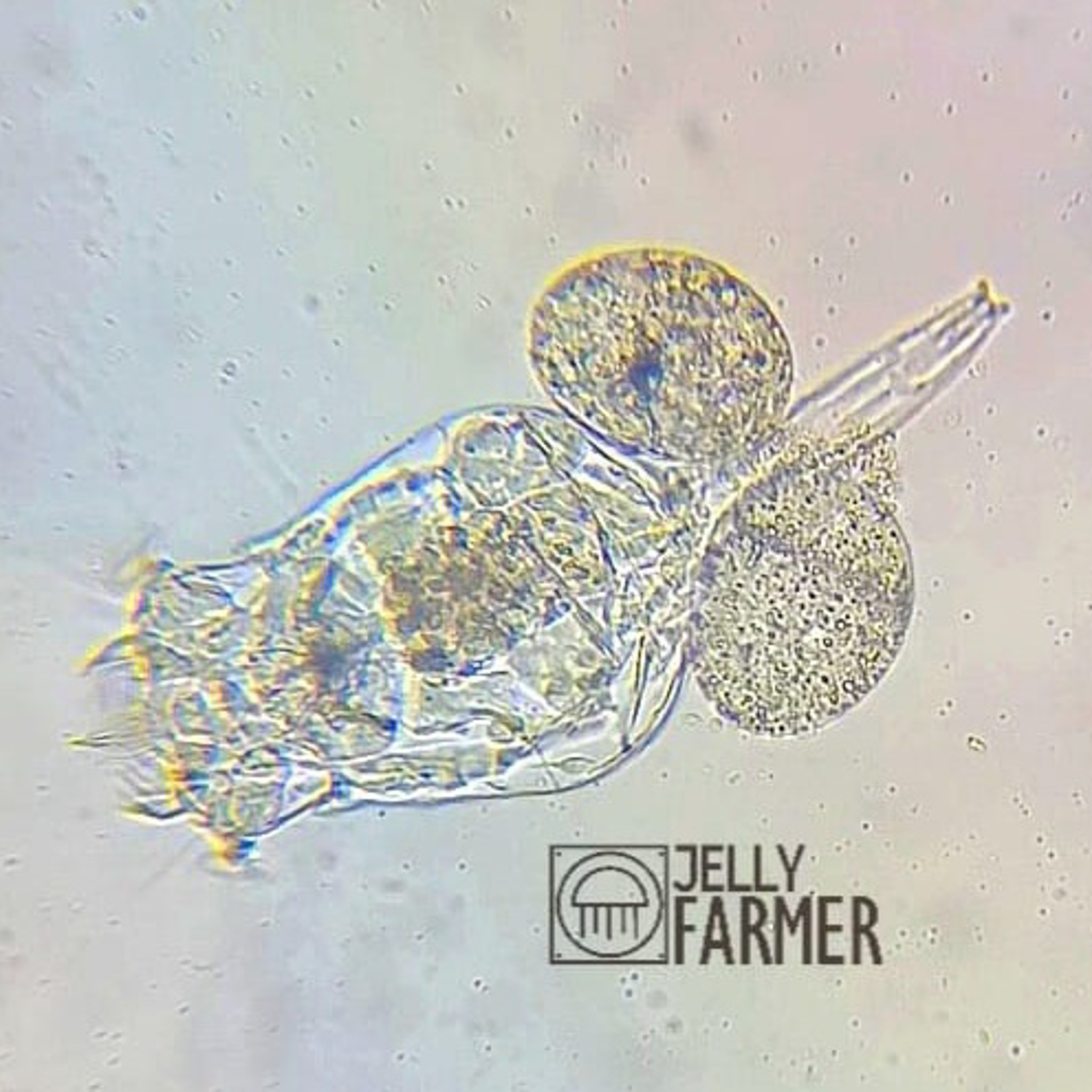
Freshwater rotifer (Brachionus calyciflorus) .
The best infusoria substitute for Betta Fish larvae , Danio Reiro, Cardinal Tetra, Neocaridina and countless other freshwater aquarium organisms with small larvae, proven survival improvement.
Instructions for use:
-Filter through a 48 micron sieve and dose as desired (more information below in the description).
-Rotifers are able to live and reproduce in the larval container, shrimp tank or freshwater aquarium.
-For better use, stop the water circulation during dosing.
-To keep the rotifer alive, store it in the refrigerator without a cap for a period of no more than 7 days.
DKK 74,36
Product not in stock - Estimated backorder time: 14 days
EAN
Product not in stock - Estimated backorder time: 14 days
Brachionus calyciflorus is a freshwater rotifer measuring 130-231 microns, scientifically validated as an optimal food source for fish and crustacean larvae. According to research published in Orinoquia (2016), this microorganism surpasses infusoria in nutrition and adaptability, thanks to:
Higher protein and fatty acid density .
The ability to reproduce in the aquarium , provided with continuous food.
Its size makes it ideal for larval species with tiny mouths, such as anabantids, rasbosas, tetras, barbs, killis, neocaridinas and filter-feeding shrimp ( Atya gabonensis ), among others.
An experiment with Betta splendens showed that:
Survival was up to 90% in larvae fed with rotifers vs 54% with infusoria.
Accelerated growth using rotifers : Larvae reached 10.1 mm in 19 days with rotifers, compared to 7.9 mm with infusoria.
Which species can benefit from this food?
This organism is widely used in commercial hatcheries, conservation projects, and scientific studies. There is ample evidence supporting its use; in fact, any fish larva that struggles to eat brine shrimp nauplii in its early stages will benefit from this food. Among these, we have found evidence with larvae of:
1. Tetras
– Paracheirodon axelrodi (Cardinal tetra)
– Paracheirodon simulans (Neon green tetra)
– Hemigrammus rhodostomus (Drunken/red-nosed tetra)
– Hyphessobrycon herbertaxelrodi (Black tetra)
– Hyphessobrycon amandae (Fire tetra)
2. Cichlids
– Symphysodon spp. (Disc fish)
– Pterophyllum scalare (Angelfish)
– Mikrogeophagus ramirezi (Ramirez dwarf cichlid)
– Apistogramma spp. (Dwarf cichlids)
3. Killis
– Nothobranchius guentheri (Annual Killi)
– Fundulopanchax gardneri (Gardner’s Killi)
– Aphyosemion australe (Lyretail Killi)
4. Coridoras
– Corydoras aeneus (Bronze Coridora)
– Corydoras paleatus (Marble Coridora)
– Brochis splendens (Emerald Coridora)
5. Labyrinth Fishes (Anabantids)
– Betta splendens (Siamese Fighting Fish)
– Trichogaster lalius (Dwarf Gourami)
– Trichopodus trichopterus (Three-spot Gourami)
6. Rasboras
– Trigonostigma heteromorpha (Harlequin/heteromorphic rasbora)
– Celestichthys margaritatus (Celestial Rasbora/galaxy fish)
– Boraras brigittae (Mosquito Rasbora)
7. Hatchetfish
– Carnegiella strigata (Marble Hatchetfish)
– Carnegiella marthae (Black Hatchetfish)
8. Barbels
– Puntius titteya (Cherry barbel)
– Pethia conchonius (Pink barbel)
9. Additional Species
– Neocaridina (Freshwater Shrimp)
– Nannostomus beckfordi (Golden Pencilfish)
– Atya gabonensis (Filter-feeding Shrimp)
What advantages does the Freshwater Rotifer have over Infusoria?
Superior nutrition : Greater nutritiousness per unit preyed upon, that is, rotifers provide concentrated energy, vital for the rapid development of larvae during their most sensitive initial stages.
Less pollution : Unlike infusoria, they do not proliferate in dirty environments loaded with nutrients.
Adaptability : They survive in fresh water without altering parameters or polluting the water.
Optimal Dosage
Filter with a 48 micron sieve : Concentrates the rotifers and removes impurities.
Dose 3-5 times a day : Maintain a density of 10-30 rotifers/mL (adjusted 3-5 times/day).
Stop the water circulation after feeding : This prevents rotifers from accumulating in the filter (resume it after a while).
Dose it for at least one or two weeks (depending on the species), as the days go by, gradually introduce artemia nauplii into the larvae’s diet.
Conservation
Store in refrigerator (4-8°C) uncovered : Maximum 7 days
Brachionus calyciflorus is not just a food source, but a scientifically backed investment that your fish fry will thank you for. Its adaptability to the aquarium, high nutritional value, and ease of use make it the most efficient option for optimizing fish and shrimp breeding. Now, thanks to Jellyfarmer, it’s arriving in Europe for the first time at an affordable price , allowing all aquarists and breeders to take advantage of its benefits for the healthy growth of their fry.