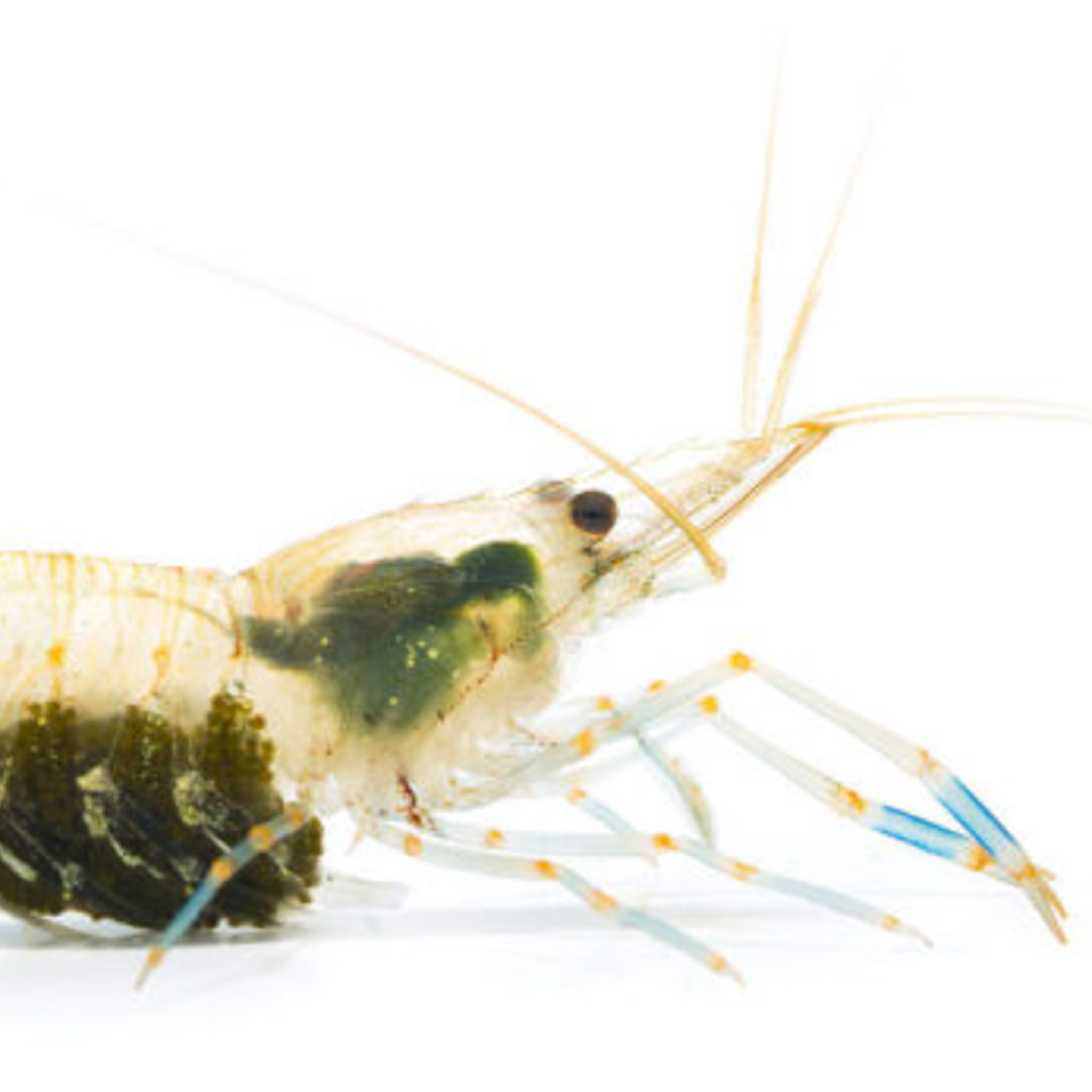
Food for predators ( Moray eels, Pterois, Scorpaenas, Anthenarius, Cuttlefish, Octopuses, Large wrasses, Large abalone…)
Improved survival rate and growth rate of hard-to-feed fish and cephalopods
From 2.5 to 5 cm
Feed one shrimp 2-3 times per week depending on the species and size.
DKK 4,98
Product not in stock - Estimated backorder time: 14 days
EAN
Product not in stock - Estimated backorder time: 14 days
Palaemon as live food for marine fish: a practical guide
What is Palaemon?
The genus Palaemon includes “shrimp” or prawns typical of intertidal pools, coastal areas and estuaries.
Habitat and behavior that matter in aquariums
They are nocturnal/crepuscular animals and very sensitive to low oxygen levels . They like to hide among macroalgae and rocks. This gives us two clues: 1) ensure strong oxygenation in the tank; 2) provide them with shelters (nets, mesh, bio-balls) to reduce stress and cannibalism. I have found that by maintaining correct parameters and adding a little food in flakes, survival increases indefinitely.
Why use Palaemon: real benefits in the aquarium
The first reason is behavioral . “Natural prey = real hunt.” When I offer live shrimp, the fish display ambush and pursuit instincts. This reduces stress and breaks the apathy of timid or newly imported individuals. For fish arriving from the sea that won’t accept dead food , Palaemon is the bridge to frozen foods (for example, krill).
Nutritionally, the prawn provides quality protein and a fraction of omega-3.
In my day-to-day work, I notice three advantages that I repeat to clients:
“ Improved appetite and vitality ”: after several hunting sessions, sedentary fish gain muscle tone.
“ More natural color ”: the supply of carotenoids and exercise itself refine pigmentation.
Faster “ Food transition ”: alternate live → live mixed with frozen → frozen only.
Nutrition and how to “gut-load” it
If the goal is not only to stimulate but also to nourish , gut-loading is advisable before feeding the shrimp, meaning feeding the shrimp before offering it to the prey. You can use spirulina, nori, flakes , or micro-pellets with vitamins, and—if appropriate—specific marine-grade enrichment supplements.
Which fish and cephalopods eat it?
Palaemon is a wild card here . It is used for:
Typical marine carnivores
Lionfish ( Pterois ), scorpionfish ( Scorpaena , juvenile Sebastes ), moray eels ( Gymnothorax , Echidna ), juvenile groupers ( Serranus , Cephalopholis , Epinephelus ), powerful wrasses ( Thalassoma , Bodianus , Coris ), large halicoeres, rockfish (Anthenarius), and even carnivorous tetradontiforms (Arothron, Rhinecanthus). In my experience, the movement of the shrimp activates the laziest ones; with Pterois , for example, it readily accepts.
For brackish : scats ( Scatophagus ), archers ( Toxotes ), monodactyls ( Monodactylus ).
Even freshwater fish can benefit from this food, such as Arowanas and large cichlids.
Cephalopods.
Cuttlefish ( Sepia officinalis , S. bandensis ), octopuses ( Octopus spp.) and juvenile squid respond wonderfully.
5) Palaemon Maintenance
The shrimp “hotel” doesn’t need to be glamorous, but it does need to be oxygenated and stable .
Container/shelter assembly (marine/brackish)
Container : food-grade plastic box or sump/shelter.
Water : same salinity as the original; if you are going to change it, do so by acclimatizing it.
Powerful aeration : large diffuser stone or soft skimmer.
Shelters : nets, bio-balls, pieces of sponge; less fighting and mortality.
Density : better a small amount per liter than to see a “sack” of shrimp piled up.
How to offer it: dosage, frequency, and transitions
Less is more . Offer a few pieces and observe. If the predator misses frequently, dim the light or reduce the current so the prey doesn’t “fly away.”
Regarding frequency , with voracious predators (e.g., Pterois ) I alternate 2–3 times/week live with frozen .
When I want a transition , I use a trick: I hold Palaemon with a tweezer next to a piece of krill and get it to eat both of them.
Quick FAQs about Palaemon as live food
Can I keep them in both marine and brackish water?
Yes. They are euryhaline, so they can acclimate to your preference.
How long do they live in the “hotel”?
With aeration, food, and filtration, indefinitely.
Are they useful for starting wild fish that won’t eat?
Absolutely. In my experience, they’re the best way to transition to frozen food for picky carnivores.
How much to give?
Start with 2–3 prey items per week and observe hunting and digestion; adjust the following week if necessary.
Conclusion
Palaemon is the most versatile live food for marine, brackish, and freshwater environments: it awakens instinct, stimulates appetite, and facilitates transitions. If you set up an oxygenated shrimp hotel and use gut-loading techniques effectively, the shrimp will perform exceptionally well… and your predators will “thank” you with improved health, color, and activity.